Extrafinance Lending and Leveraged Farming
Updated ·
Extrafinance connects asset lending with leveraged yield farming, where borrowed assets increase the size of a liquidity-providing position. Built on Optimism and Base within the Superchain ecosystem, it lets depositors earn lending interest while farming vaults draw on that liquidity. The vaults build positions in supported Velodrome or Aerodrome pairs. Farming strategies can customize borrowing ratios and directional exposure. Lending returns depend on borrowing activity; farming outcomes also reflect liquidity rewards, debt costs, and changes in the paired assets.
How Does Lending Support Leveraged Farming?
Lending pools supply the assets farming vaults borrow, connecting depositors' interest income with demand for leveraged liquidity positions. Each supported lending asset has its own pool. A vault draws liquidity from the relevant pool and owes repayment to that pool. A lending deposit contributes funding without requiring its owner to open a leveraged farming position.
Pool Shares and Lending Income
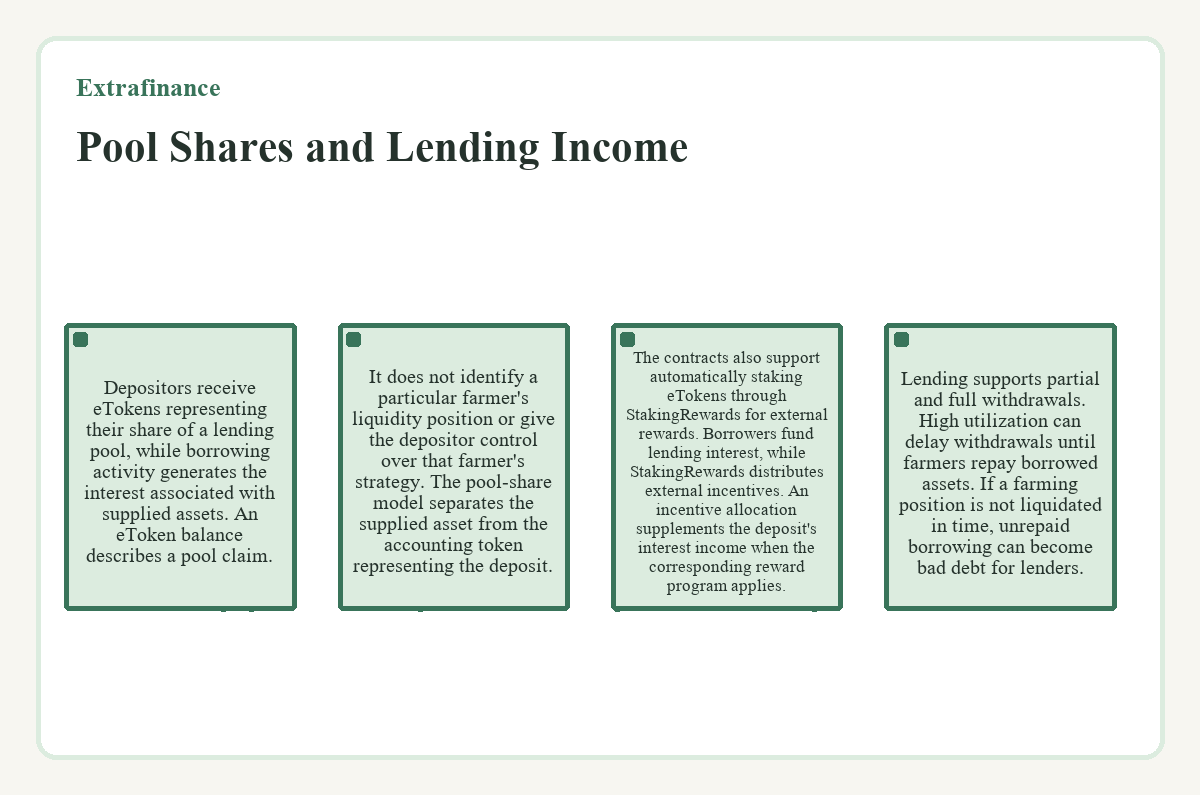
Depositors receive eTokens representing their share of a lending pool, while borrowing activity generates the interest associated with supplied assets. An eToken balance describes a pool claim. It does not identify a particular farmer's liquidity position or give the depositor control over that farmer's strategy.
The pool-share model separates the supplied asset from the accounting token representing the deposit. The contracts also support automatically staking eTokens through StakingRewards for external rewards. Borrowers fund lending interest, while StakingRewards distributes external incentives. An incentive allocation supplements the deposit's interest income when the corresponding reward program applies.
Lending supports partial and full withdrawals. High utilization can delay withdrawals until farmers repay borrowed assets. If a farming position is not liquidated in time, unrepaid borrowing can become bad debt for lenders.
Farming Vaults and Liquidity Rewards
Farming vaults combine deposited capital with borrowed assets to create larger liquidity positions in their supported trading pairs. Each vault corresponds to a specific Velodrome or Aerodrome pair. That relationship determines where the liquidity works and which paired assets govern the position's exposure.
Principal and Borrowed Liquidity
The vault receives the farmer's principal and borrows assets before supplying them to an automated market maker, whose paired liquidity supports swaps. The protocol adjusts the supplied and borrowed assets into the ratio the pool accepts, then creates liquidity-provider tokens, commonly called LP tokens. These tokens represent the farming position's liquidity exposure. Borrowing enlarges the position while leaving an obligation denominated in the borrowed assets. A change in an asset's price can therefore affect the value held in the LP position and the value owed differently. Changes in the pair's price ratio can cause impermanent loss: the LP assets underperform the same assets held outside the pool, excluding fees and rewards.
Borrowing interest and the borrowing fee are separate charges. Interest accrues on outstanding debt. The pool-specific borrowing fee charges a portion of the borrowed amount when the farming position closes.
Rewards and Reinvestment
Farming rewards undergo periodic collection, conversion, and reinvestment into LP tokens. Reinvestment can increase the quantity of LP tokens associated with the position. Their quantity and market value describe different properties: more LP tokens do not, by themselves, establish a higher net return after debt costs and price changes. Reinvestment also carries a protocol fee.
Borrowing Ratios and Strategy Exposure
Borrowing ratios influence directional exposure because a farming position holds paired assets while owing the particular assets its vault borrowed. The same farming pair can support different long or short viewpoints when the borrowed-asset mix changes. The market-neutral strategy combines long and short positions to offset exposure to the volatile asset in a pair. The long and short positions need matching opposing exposure for the intended hedge to apply. Both positions still incur their applicable borrowing costs and retain liquidation exposure.
Stablecoin and LST Borrowing Costs
The pseudo-fixed interest rate model targets stablecoin and pegged liquid staking token pools with a steadier borrowing-rate region below a utilization threshold. Liquid staking tokens, or LSTs, represent staked-asset exposure. The model addresses funding-cost sensitivity in these pools, where borrowing interest can consume a substantial part of farming rewards.
Borrowing Rates and Lending Returns
Utilization describes how much lending liquidity borrowers use. Below the model's threshold, the borrowing rate follows its relatively stable region. Lenders' interest income still reflects utilization as well as the borrowing rate. A stable borrowing-rate setting therefore does not imply an identical lending return at every level of borrowing demand.
The listed lending reserve fee takes 15% of lenders' borrowing-interest income. The application displays lending APY after fees, so subtracting that reserve fee again would double-count the same deduction. Annual percentage yield, or APY, expresses an annualized return with compounding; it does not establish the amount a changing rate will produce over a future year.
Utilization Above the Threshold
Borrowing costs rise sharply after utilization reaches the model's threshold, encouraging repayment and additional lending deposits. These incentives support the model's withdrawal buffer. The application also restricts new borrowing at high utilization. Existing positions remain exposed to the applicable borrowing rate. Governance can revise rate settings as demand and market conditions change.
Debt Ratios and Pool-Specific Limits
A farming position becomes eligible for liquidation when its debt ratio exceeds the pool's threshold. This ratio equals borrowed-asset value divided by total position value. A fall in position value can increase that ratio. The applicable liquidation threshold belongs to the selected pool and can change through governance. Stablecoin and pegged LST pairs retain this risk when their price relationship breaks down.
Safe Liquidation 2.0 generally repays debt through partial liquidation, after deducting the liquidation bounty from the liquidated portion. Position size and liquidity depth affect the portion it liquidates; very small positions can undergo full liquidation. The older full-liquidation process also remains a backup. Repeated partial liquidations may leave unleveraged LP assets. Severe price movements can still exhaust the position's equity.
Only whitelisted vault contracts created through VaultFactory can borrow from the leveraged farming lending pools. Vaults also enforce leverage and borrowing limits. Pool-specific borrowing caps can prevent a new position even while the lending pool still holds assets. A temporary restriction on opening leveraged positions can also reflect liquidity-proportion controls, without removing the pool itself.
Audits, Token Locks, and XLend
BlockSec, Sherlock, and PeckShield have audited Extrafinance, with findings specific to the code and review scope each audit examines. Contract configuration uses multi-signature controls for parameters including fees and liquidation thresholds. The Price Feed table updated on May 10, 2024 lists AMM prices as the default liquidation feed. It specifies a 30-minute time-weighted average price (TWAP) for assets with adequate liquidity, low volatility, and strong fundamentals. For Chainlink-supported assets on Optimism, the documented divergence check reverts liquidation transactions when TWAP, current on-chain, and Chainlink prices differ beyond the allowed threshold.
Tokenomics V1 is retained as reference material for locking EXTRA to obtain veEXTRA. Tokenomics V2 uses veEXTRA for governance and weekly EXTRA rewards from emissions and protocol fees. Its utility schedule lists minimum balances of 10 000 veEXTRA for higher leverage or premium borrowing at high utilization, and 4 000 veEXTRA for one-click rebalancing. That token lock differs from an eToken lending-pool share or a farming LP position. Extrafi XLend is a distinct lending product with a multi-account system for lending and borrowing. Its account-based features belong to XLend; the vault-linked borrowing model described here concerns the leveraged farming lending pools.
Choosing Between Lending and Leveraged Exposure
The choice between lending and farming changes both the source of returns and the meaning of the position balance. A lending balance represents supplied pool shares. A farming balance combines liquidity-pool exposure with a separate debt obligation.
- Identify whether the balance represents eTokens or exposure through a farming vault's LP position.
- Separate the farming position's debt value from its gross position value.
- Match the borrowed-asset ratio to the intended long, short, or hedged exposure.
- For a stablecoin or LST pool, distinguish the borrowing-rate regime below its utilization threshold from the regime above it.
- Use the selected vault's leverage limit, borrowing cap, and liquidation threshold when interpreting the configuration.
A larger farming position may reflect added borrowings. Farming equity equals position value minus debt value. Lending-pool shares express a claim on supplied liquidity; farming equity expresses the position value remaining after its debt. Changes in paired-asset prices or the value of borrowed assets can change that equity comparison.
Extrafinance - common questions
Can I Deposit Only One of a Farming pair's Assets?
A supported farming position can accept either asset in its pair or both assets. The protocol then combines the deposit with the selected borrowings and adjusts the assets into the liquidity pool's required ratio. Supplying one asset does not mean the resulting LP position holds only that asset.
Does Connecting a Wallet Create a Lending Position?
Connecting a wallet does not deposit assets into a lending pool. The lending process requires a deposit transaction and wallet confirmation. After a successful deposit transaction, the application displays the lending position.
What Does the Farming Position Simulation Show?
The farming simulation shows the strategy breakdown and estimated profit or loss for the selected configuration. Leverage and the assets chosen for borrowing shape that estimate. The displayed estimate describes a modelled outcome; changing prices, borrowing rates, and farming rewards can alter the position's eventual result.
When Can I Unlock EXTRA Under Tokenomics V1?
Under the reference Tokenomics V1 rules, EXTRA becomes eligible for unlocking when the chosen lock period ends at a weekly epoch boundary. The staking interface records the locked amount and its duration separately from pending rewards. Rewards become claimable after a full eligible epoch ends. A lock begun mid-epoch earns no rewards for that partial epoch. Reward timing does not permit early unlocking of the EXTRA principal.
Are Blockchain Gas Charges Included in a Zero Protocol Entry Fee?
Blockchain gas charges are separate from protocol entry fees. Lending and farming transactions on Optimism require ETH for on-chain gas. A zero protocol entry fee describes the protocol's own charge for entry; it does not waive the network cost of executing the transaction.