Extrafinance leveraged farming: Debt and Asset Exposure
Updated ·
Extrafinance leveraged farming combines deposited assets with loans from lending pools to build a liquidity position in a supported trading pair. The farming vault holds that liquidity and owes the borrowed assets, so borrowing choices shape its repayment obligation and price exposure while reinvested rewards and borrowing interest change the farm's value over time.
The deposit asset, assets represented by the liquidity position, and borrowed assets describe different parts of the same farm. Their relationship explains why positions with similar leverage can respond differently to price changes and accumulate different financing costs.
Lending Pools, Farming Vaults, and LP Tokens
Lending pools fund farming vaults, which manage leveraged positions, while liquidity provider (LP) tokens represent the liquidity those positions supply.
Funding From Lending Pools
Each lending asset has its own pool. Depositors supply that asset and receive eTokens representing their pool share. A farming vault borrows available liquidity from the appropriate pools and owes repayment. Only whitelisted vault contracts created through the VaultFactory may call the lending pool's borrowing and repayment functions. This restriction connects lending liquidity to supported farms without creating an unrestricted borrowing account for every wallet.
Liquidity in the Farming Vault
A farming vault targets a particular Velodrome or Aerodrome pair. The vault receives principal in either paired asset or both and borrows the configured assets, then the protocol swaps the combined funds into the ratio the pair's automated market maker (AMM) requires and supplies liquidity to mint LP tokens. Those tokens describe liquidity in the pair; they do not represent the farm's value after subtracting its debt.
How Does the Borrowed Asset Change Exposure?
The borrowed asset changes exposure because the farm owes that asset while its LP position holds a mix of paired assets. The leverage multiplier describes position size relative to equity (position value minus debt value). It does not identify which asset the farm must repay.
USDC Debt and Long Exposure
Borrowing USDC for ETH/USDC liquidity leaves the farm holding ETH through its LP position while owing USDC. ETH price changes therefore affect the assets held without creating an ETH repayment obligation. Additional USDC borrowing can increase that long exposure. The AMM adjusts its token mix as prices move, so the farm does not behave exactly like a fixed quantity of ETH held outside a pool.
ETH Debt and Short Exposure
Borrowing ETH creates a liability whose value moves with ETH's price. When that liability exceeds the ETH exposure represented by the LP position, the difference produces net short exposure, while an ETH debt smaller than the LP position's ETH exposure leaves net long exposure. Falling ETH prices can help within the short strategy's applicable price range. Rising prices can increase the debt's value.
Reinvestment and the Cost of Debt
Automatic reinvestment converts collected farming reward emissions into additional LP tokens. Subsequent rewards accrue to the enlarged liquidity position, while borrowing interest accumulates on the assets the vault owes. Annual percentage rate (APR) describes an annualized rate without compounding; annual percentage yield (APY) includes compounding assumptions. A leveraged return estimate combines farming income on the position with financing costs on its debt and reinvestment fees. Changes in emissions, borrowing rates, or paired-asset prices change the outcome, so a compounding projection cannot fix the value of the underlying assets.
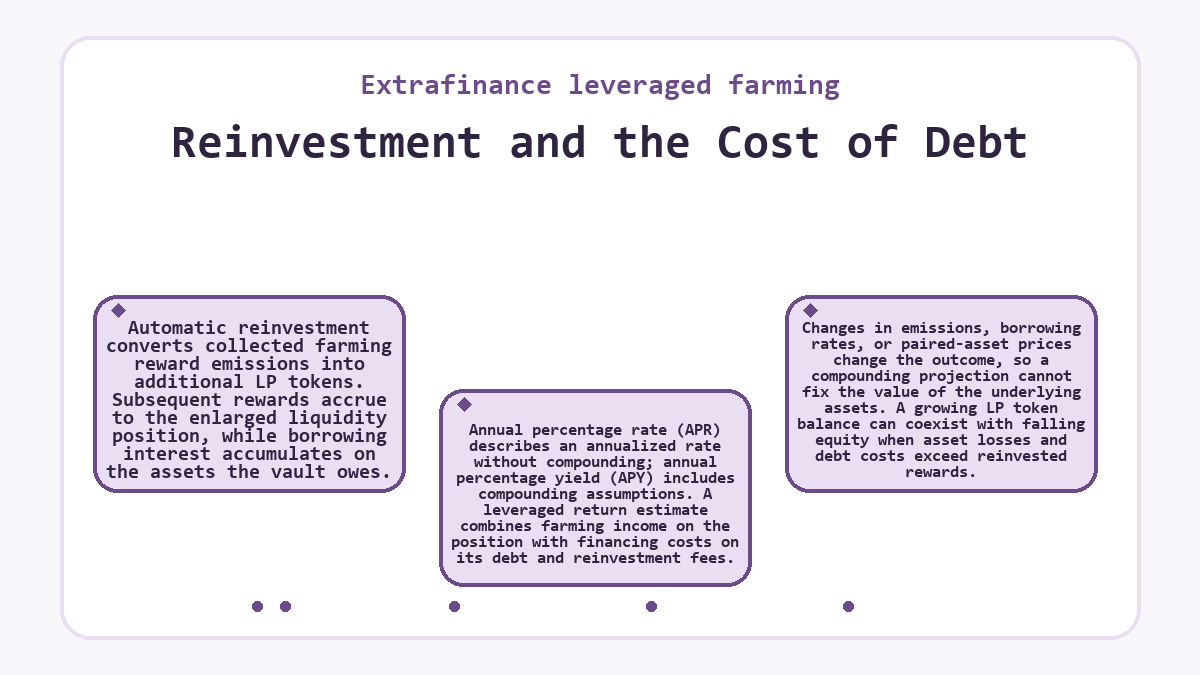
A growing LP token balance can coexist with falling equity when asset losses and debt costs exceed reinvested rewards.
Debt Ratios and Liquidation Versions
The debt ratio equals the farm's debt value divided by its total position value. The liquidation threshold belongs to the selected pool. Changes in LP value or borrowed-asset value move this ratio, while interest increases the obligation even without a new loan. A farm can reach its threshold through falling collateral value, rising debt value, or both.
Safe Liquidation 2.0
Safe Liquidation 2.0 usually liquidates a portion of the position and applies the proceeds, after the liquidation bounty, to debt repayment. It aims to lower the remaining farm's debt ratio. Pool liquidity and position size can affect the portion liquidated. The documented parameters specify full liquidation for positions worth less than $1. Further adverse price movement can cause additional liquidation. The process can eventually leave LP assets without leverage for the user to withdraw, although severe losses can also leave nothing.
Liquidation 1.0 Backup
Liquidation 1.0 remains the full-closure backup: it uses the whole farm for debt repayment and returns any remainder after the liquidation bounty.
Strategy Choices and Exposure Limits
Debt selection establishes directional exposure, automatic reinvestment handles rewards, and paired assets determine relative-price risks. A pseudo delta neutral (PDN) strategy combines long and short positions to offset their initial exposure. These choices can overlap within the same farming arrangement.
| Farming Choice | Loss Conditions and Limits |
|---|---|
| USDC borrowing for long ETH exposure | Falling volatile-asset prices can outweigh farming income. |
| ETH borrowing for net short exposure | Short farming can profit from ETH price falls within a specific range, while rising prices increase the debt's value. |
| PDN long and short farming | Price changes can disturb the hedge, requiring rebalancing. |
| Automatic reinvestment | Additional LP tokens still face changes in the pair's value and ongoing borrowing costs. |
| Stablecoin-pair farming | A relative depeg can push the debt ratio beyond the pool's liquidation threshold. |
| Liquid staking token pair farming | A breakdown in the expected relative-value relationship can raise liquidation risk. |
Each side of a PDN hedge retains its own debt, borrowing costs, and liquidation threshold. Reinvestment handles farming rewards, while rebalancing maintains the intended relationship between the two sides' price exposure.
Can a Farm With a Stable Pair Still Liquidate?
Stable-pair farms can liquidate if a relative depeg lifts the debt ratio beyond the selected pool's threshold. Stablecoin pairs rely on their assets maintaining the intended relative value. Liquid staking token (LST) pairs carry a related condition: the tokens must maintain their expected relative-value relationship. A breakdown can lower the LP position's value relative to the borrowed asset, reducing the equity available to absorb losses. Borrowing costs also continue during the disruption.
Unleveraged liquidity provision carries the pair's price risk, while farming debt adds interest costs and a liquidation threshold.
Extrafinance leveraged farming: what people ask
Must Both Sides of a PDN Hedge Receive Equal Deposits?
A PDN hedge does not require equal deposits in its long and short farms. The relevant relationship is the offset between their net asset exposures after borrowing and LP allocation. Different borrowing choices can require different deposit sizes to create that offset, and matching deposits alone does not establish a neutral hedge.
Does Each Farming Pair Offer the Same Maximum Leverage?
Maximum leverage varies by farming pool and its risk settings. Vaults enforce leverage checks and borrowing limits, so the available multiplier belongs to the specific farm. A strategy label such as long or PDN does not establish an identical maximum across pairs, and configuration changes can alter the available limit.
Where Does Price Impact Enter a farm's Opening Value?
Price impact enters when the protocol swaps deposited and borrowed assets into the mix required for LP creation. Those swaps can move the underlying pool's price, with pool depth and trade size affecting the impact. Trading costs can also put the resulting position value below a simple deposit-plus-debt calculation.
When Does a Farming Borrowing Fee Apply?
A configured farming borrowing fee applies when the position closes and uses the borrowed amount as its basis. This charge differs from interest accruing over the loan's life. Individual farming pools set their borrowing fees, so one pool's fee does not establish the charge for another farm.
Can a price-range Trigger Close a Farm Before Its Debt Ratio Reaches Liquidation?
A configured price-range trigger can close a farming position when the market price leaves the range the user set. This closure uses a separate condition from debt-ratio liquidation. The price-range trigger fee applies only when the configured price-range closure actually triggers.
Are Displayed Farm Values Always Priced Like Liquidation Triggers?
Displayed farm values and liquidation triggers can use different price calculations. The Price Feed specification updated May 10, 2024 lists AMM pricing for the display and distinguishes direct pricing from a 30-minute time-weighted average price for liquidation. The averaged option covers assets with adequate liquidity, low volatility, and strong fundamentals. For Chainlink-supported assets on Optimism, additional price-consistency checks can revert liquidation during abnormal price divergence.
Is Impermanent Loss Limited to Falling Token Prices?
Impermanent loss can arise when either asset's price changes relative to the other, in either direction. It compares the LP outcome with holding the same asset quantities outside the pool. Farming rewards and borrowing interest affect the leveraged farm's overall outcome separately from that comparison.
Can I Trigger auto-compounding From Any Wallet?
A wallet can call the position manager's reinvestment function only when it is whitelisted or permissionless compounding is enabled. Owning a farm alone does not grant that permission. The restriction concerns who executes compounding; a supported farm can receive reinvested rewards through an allowed caller.